
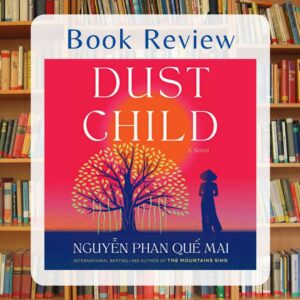
Dust Child: A Novel by Que Mai Phan Nguyen
Book Review by Kristine Madera
 Set in both wartime and 2016 Vietnam, Dust Child by Que Mai Phan Nguyen brings readers into an immediately captivating tapestry both heart-wrenching and hopeful of the experience of women surviving the war by working as bar girls, prostitutes, and girlfriends of foreign GIs, of soldiers finding refuge from the trauma of war in the arms and beds of these women, of the resulting Amerasian children born and raised in Vietnam, and of American and other foreign soldiers returning to Vietnam to heal old wounds and find their children.
Dust Child follows sisters Trang and Quỳnh, whose friend woos them to Saigon in wartime with the promise of making money to pay their parent’s debt by drinking tea and flirting with foreign soldiers in bars. The older, yet more innocent, Trang falls in love with Dan, an American helicopter pilot who arrives in Vietnam friendly, charming, and sure he is helping his country until the realities of war set in.
Another thread takes place in 2016, when Dan, who has suffered from PTSD since the war, returns with his wife to Vietnam to heal the trauma of war, and, unbeknownst to his wife, to look for Trang and their child whom she was pregnant with when he left.
A third thread follows Phong, the child of a Vietnamese woman and a Black soldier who, like many Amerasian children, was left at an orphanage as a baby and grew up being called “the dust of life” and “child of the enemy.” Phong, though a survivor, wrestles with the lifelong discrimination of being a child of the enemy, the pain of being abandoned, and various schemes to get to the US and find his father.
Dust Child touches only briefly on the military events of the Vietnam War and focuses squarely on the war’s human cost, not in the lives lost, but the lives irrevocably changed, by both the Vietnamese people and the foreign soldiers. Though it’s a fundamentally hopeful story of healing and finding connection, it’s also a reminder of the many layers and generations of trauma that are always reaped when the seeds of war—any war—are sown.
NOTE: Apologies to Dr Nguyen for the lack of proper accent marks and Vietnamese spelling in this review. As she points out in the book, and as is true in many languages, different accent marks and the lack of accent marks change the meaning of names and words, and not always in good ways. My keyboard options don’t offer Vietnamese options.


About Kristine
Kristine Madera is an Amazon #1 bestselling author who writes fiction and nonfiction shaped by travel, culture, and lived cross-cultural experience.
Inspired while volunteering at Mother Teresa’s Home for the Dying in Calcutta, her novel God in Drag examines what happens when spiritual faith fractures in the sacred city of Varanasi. Read the first chapter of God in Drag HERE
She birthed her upcoming novel, The Snakeman’s Wife, as a Peace Corps Volunteer in Papua New Guinea.
Be on the lookout for her Etiquette Express Guides, a series of short, practical travel guides that help readers understand the customs, social expectations, and everyday dos and don’ts that make travel smoother and more connected.
Her travels have taken her across India, Asia, Europe, Australia, and Papua New Guinea as both a backpacker and Peace Corps Volunteer. A portion of her book proceeds supports cross-cultural education scholarships.